Federal projects · NEPA

What are you proposing, and where?

Draft a NEPA environmental assessment and FONSI, or an EIS outline, that follows a reference document. Free to read; every unconfirmed fact is marked.

  • Free to read
  • No sign-up until the draft
  • Every fact cites its source

ePlan fills in

  • Lead agency and its NEPA procedures
  • Listed species and critical habitat
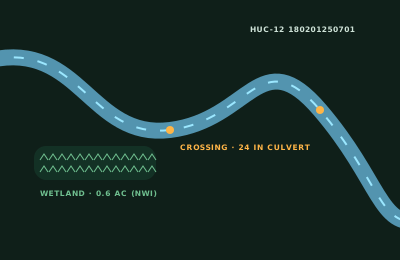
  • Wetlands
  • Floodplains
  • Streams and impaired waters

How it works

Environmental assessment, from one answer

  1. Describe the projectOne answer starts the project. ePlan names it and looks up the place.
  2. Pick the agency and the document3 more questions, each with a "not sure yet" way out.
  3. Read the draft free; download it for $49The draft marks what to check (amber), what to pick (blue) and what to fill in (violet).

What you get

Environmental assessment and 2 more documents

The first draft is free to read. Each document after it is drafted from the same confirmed facts.

The first draft

Environmental assessment

  1. Cover: lead and cooperating agencies, responsible official
  2. Purpose and need
  3. Proposed action and alternatives, including no action
  4. Affected environment and environmental effects, by resource
  5. Mitigation and monitoring commitments
  6. Agencies, tribes and people consulted

Modeled on: A signed EA from the same agency and project type
Next · 2

Draft finding of no significant impact (FONSI)

  1. Decision and the alternative selected
  2. Why the effects are not significant
  3. Mitigation the decision relies on
  4. Public involvement
  5. Responsible official's signature
Next · 3

EIS outline and notice of intent

  1. Notice of intent: proposed action, alternatives, expected issues, schedule, request for comment
  2. Purpose and need
  3. Alternatives
  4. Affected environment and effects
  5. Public comment summary
  6. Page limit: 150, or 300 if extraordinarily complex

From public data

What ePlan fills in, and from where

75 pages

NEPA's limit for an environmental assessment, not counting citations and appendices. An EIS gets 150.
Source: 42 U.S.C. 4336a(e)

Questions

NEPA environmental assessment: what people ask

Do I need an EA or an EIS?

An agency prepares an EIS when a proposed action has a reasonably foreseeable significant effect on the human environment, and an EA when it does not or the significance is unknown. If one of the agency's categorical exclusions fits, neither is needed.

Source: law.cornell.edu

How long can an EA take?

One year. NEPA gives a lead agency one year to finish an EA and two years for an EIS, counted from the earliest of its decision that the document is needed, notice that a right-of-way application is complete, or, for an EIS, its notice of intent.

Source: law.cornell.edu

Can the applicant write the EA?

Yes. NEPA requires lead agencies to let a project sponsor prepare an EA or EIS under the agency's supervision. The agency must independently evaluate the document and takes responsibility for its contents.

Source: law.cornell.edu

Do the CEQ regulations still apply?

No. CEQ removed its NEPA regulations effective April 11, 2025. Agencies now work from the statute and their own procedures, such as USDA's at 7 CFR part 1b. Ask which procedures your agency adopted before you pick a format.

Source: federalregister.gov

The rules this door follows